Special price
Delivery charges and applicable taxes are calculated at checkout.
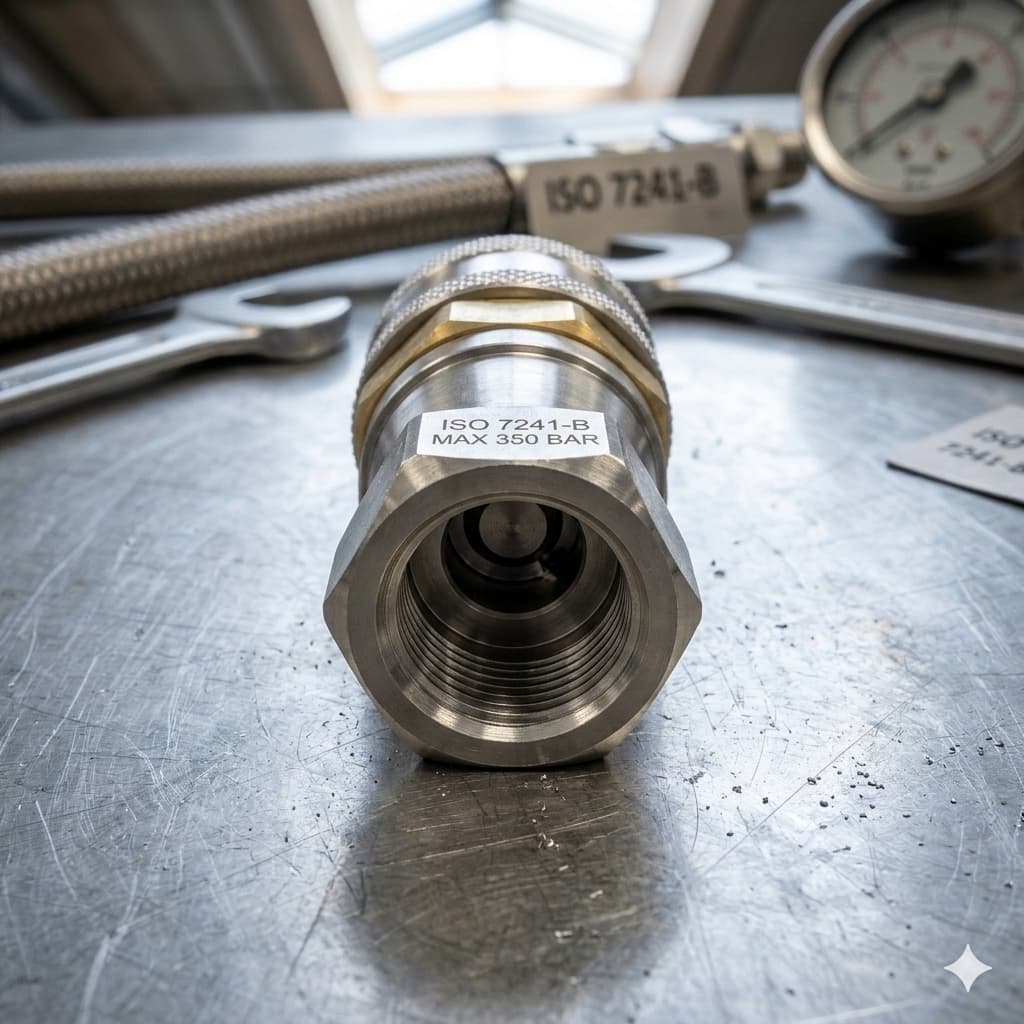
A hydraulic coupling (commonly referred to as a quick-disconnect coupler or QRC) is a highly engineered mechanical fitting designed to establish a rapid, leak-proof, and repeatable connection between fluid transmission lines in high-pressure hydraulic circuits. They are engineered to allow operators to swap hoses, tools, and attachments in seconds without tools, while ensuring that system pressure is maintained and environmental contaminants are locked out. 1. Functional Anatomy & How It Works A complete hydraulic quick coupling set consists of two precision-machined mating halves: • The Male Plug (Nipple): The probe-like half that inserts into the receiver. It usually houses a solid or spring-loaded core. • The Female Socket (Coupler): The receiving body that contains a spring-loaded outer locking sleeve, internal locking balls (or pins), and critical elastomeric seals (like Nitrile or Viton) to isolate fluid path zones. The Mechanism: 1. Connection: When the male plug is pushed into the female socket, the mechanical force compresses internal spring-loaded check valves in both halves. The valves shift open simultaneously, opening a smooth, unobstructed internal gallery for hydraulic oil flow. 2. Locking: The outer sleeve snaps forward via internal spring pressure, forcing hardened steel balls into a retaining groove on the male plug to mechanically lock the halves together against high system pressures. 3. Disconnection: Pulling back the female sleeve releases the locking balls. Internal springs instantly force the check valves shut before the two halves physically separate. This traps the oil on both sides, minimizing spillage and preventing air pockets from entering the hydraulic pump lines. 2. Main Design Standards & Configurations Hydraulic couplings are strictly standardized globally to guarantee interchangeability across international machinery brands. The major styles include: ⚙️ Flat Face Couplings (ISO 16028) • Design: Features flat, flush mating faces on both the plug and socket. • Advantages: Zero fluid spillage during disconnection and near-zero air entry during connection. The flat faces are incredibly easy to wipe clean before mating, preventing job site dirt from destroying sensitive hydraulic valves. • Common Applications: Modern skid-steers (Bobcat, CAT), excavators, demolition attachments, and high-purity industrial plants. ⚙️ Poppet & Ball Valve Couplings (ISO 7241 Series A & B) • Design: Relies on conical poppets or spherical metal balls backed by heavy springs to close off the fluid path. • ISO 7241-A: Widely utilized in global agricultural applications. It is the classic connection profile for farm tractors and implements. • ISO 7241-B: Frequently constructed from premium materials like brass or 316 stainless steel. It is heavily utilized in chemical lines, industrial power units, and aerospace testing equipment due to its superb chemical compatibility. ⚙️ Pioneer / Agricultural Style (ISO 5675) • Design: A specialty variation of the poppet style featuring a rugged ball-locking design. • Key Feature: Often paired with a breakaway sleeve frame setup. If a towed farm implement accidentally detaches from a moving tractor, the hose pulls straight out and disconnects automatically without tearing the hydraulic lines open. ⚙️ Screw-to-Connect / Threaded Couplings • Design: Replaces the push-to-lock ball sleeve with a heavy-duty outer threaded collar that manually screws onto the male plug. • Advantages: Exceptionally resilient against violent pressure spikes, continuous pulsing, and severe physical vibrations. Crucially, the mechanical advantage of the threads allows operators to connect or disconnect the lines even when high residual thermal pressure remains trapped in the system. • Common Applications: Hydraulic rescue tools (jaws of life), heavy vibratory hammers, and ultra-high-pressure jacking gear. 3. Core Specification & Selection Variables When sourcing or designing a hydraulic coupling circuit, engineering parameters must be perfectly balanced: • Body Size: The internal volume profile (typically ranging from 1/4", 3/8", 1/2", 3/4" up to 2"). The physical body size must match the target flow rate (GPM/LPM) to prevent extreme fluid friction, heating, and pressure drops. • Thread Type: The port connections at the back of the couplings must match the hose configuration. Common standards include NPT (National Pipe Thread), BSPP/BSPT (British Standard Pipe), JIC (Joint Industry Council 37° flare), and ORB (O-Ring Boss). • Pressure Rating: Standard mobile quick couplers are typical rated between 3,000 PSI to 5,000 PSI (200 to 350 bar), while heavy-duty thread-to-connect styles can exceed 10,000 PSI (700 bar).
tools kit , handling mannual
Ask the store about this product. Answers show here.
No reviews yet
Be the first to share your experience with this product.
 RgOnlineSale
Genuine products with a GST invoice, secure payments and easy returns, delivered across India.
Online payments are processed securely by Razorpay. UPI apps, cards and net banking are supported.
© 2026 RgOnlineSale. All rights reserved.